Song Clearance Sheet
6 sources citedCasey Jones
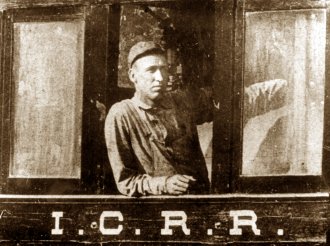
Folk Ballad1900sPictured: Casey Jones (John Luther Jones), the engineer (public domain) · source
F majKey
More in F major → · More “Public Domain” →
Key from published sheet music / hymnals
The verdict
Public Domain
In the public domain — but check the Rights Status below; a specific host's copy can carry its own caveat.
Used by independents?
Yes — it’s in the public domain — free for any independent artist to use, with no clearance needed.
Based on a real wreck
Railroad engineer John Luther "Casey" Jones died April 30, 1900 when his Illinois Central train, the "Cannonball," hit a stalled freight near Vaughan, Mississippi. He told his fireman Sim Webb to jump and stayed at the controls — every passenger and crew member survived except Jones
The original ballad
Composed by Wallace Saunders, an African American engine wiper and friend of Jones's at the Canton, Mississippi railyard, within about a week of the wreck. Saunders reportedly received a bottle of gin for the song and is remembered only for its authorship
The 1909 commercial version
Published 1909, credited to vaudeville performers T. Lawrence Seibert (lyrics) and Eddie Newton (music), marketed on the cover as "The Only Comedy Railroad Song"
A million-selling record
Billy Murray's 1910 recording reputedly sold over a million copies
Rights Status
Licenses explained →Public domain is not one blanket badge — each source can carry its own caveat
The compositionPublic domain
The early recordingPublic domain
Cultural Impact
Documented covers, adaptations, and cultural echoes — each with a real, dated source
The real widow fought a specific lyric for decades
The 1909 version implied Jones's widow, Janie Brady Jones, had been unfaithful. She spent much of the rest of her life publicly refuting it — suing a film studio in 1928 over an unauthorized Casey Jones movie, and reportedly saying in a later interview, "That devil hasn't shown up in 58 years!"
TIME · read it →
Called 'the greatest ballad ever written' by Carl Sandburg
The poet's praise is widely cited as an early mark of the song's canonization as serious American folk art, not just novelty.
Wikipedia · read it →
First blues and country recordings
Furry Lewis's two-part "Kassie Jones" (1928) is the first issued blues recording; Fiddlin' John Carson recorded the first country version in 1923; Mississippi John Hurt also recorded it in 1928 (unreleased for decades).
Mississippi Blues Trail · read it →
The Grateful Dead's famous song is NOT this ballad
The Grateful Dead's well-known "Casey Jones" is an entirely separate, historically inaccurate original composition (notably its invented claim that Jones was under the influence). Flagged clearly so the two aren't confused; Johnny Cash's version, by contrast, is one of the more historically faithful modern recordings.
FreightWaves · read it →
Institutionally preserved
Sheet music held by the Smithsonian National Museum of American History; Jones was featured on a 1950-51 U.S. Postal Service commemorative stamp honoring railroad engineers.
Smithsonian collections · read it →
Can You Use It for Free?
How to check PD →Is it public domain?Yes — free to use without clearance
References
Every source cited on this page — 6 in total
Was this page helpful?
Page history · 3 updates
Jul 2026Key added from published sheet music / hymnals (documented source)
Jul 2026Page created — full PD research (batch 8.3)
Jul 2026BPM/Key pending a separate manual keyfinder pass