Song Clearance Sheet
5 sources citedDixie
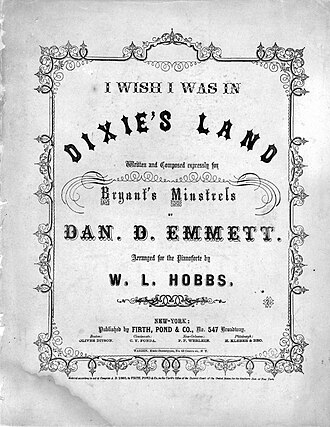
Minstrel1850sPictured: Original 1860 sheet music (public domain) · source
C majKey
More in C major → · More “Public Domain” →
Key from published sheet music / hymnals
The verdict
Public Domain
In the public domain — but check the Rights Status below; a specific host's copy can carry its own caveat.
Used by independents?
Yes — it’s in the public domain — free for any independent artist to use, with no clearance needed.
Origin
Written by Daniel Decatur Emmett, an Ohio-born minstrel performer (son of an abolitionist), for Bryant's Minstrels; first performed in New York City in 1859 as a blackface minstrel "walk-around" number
The original content, stated factually
The original lyrics are written in an exaggerated, stereotyped imitation of African American Vernacular English, depicting a freed formerly-enslaved man longing to return to the plantation of his birth — a documented aspect of the original content, stated rather than reproduced
A serious, still-disputed authorship question
Emmett gave inconsistent accounts and was slow to register copyright; multiple people claimed authorship in his lifetime. Historians Howard and Judith Sacks document a serious, still-live claim that the Snowden Family, an African American musical family from Emmett's Ohio hometown area, may have substantially originated it — a genuine unresolved scholarly question, not settled either way
Rights Status
Licenses explained →Public domain is not one blanket badge — each source can carry its own caveat
The compositionPublic domain
The early recordingPublic domain
Cultural Impact
Documented covers, adaptations, and cultural echoes — each with a real, dated source
Became the Confederacy's de facto anthem — despite the composer's Northern, abolitionist background
By 1862 the Confederacy had adopted "Dixie" as its unofficial anthem, in real tension with Emmett's own biography: an Ohio-born Northerner whose father was an abolitionist.
We're History · read it →
Also genuinely popular in the North, including with Lincoln
Despite its Confederate association, it stayed popular among Union soldiers and was reportedly a favorite of Lincoln's. Both sides wrote competing lyrics to the tune — Albert Pike added pro-Southern verses, Fanny Crosby pro-Union ones.
Songfacts · read it →
Explicitly identified as racist during the Civil Rights Movement
Activists in the 1950s–60s specifically campaigned to ban the song from sporting events and public performances, citing its offensive racial stereotyping.
Songfacts · read it →
Still surfaces in modern music
Mickey Newbury wove its opening verse into his 1972 medley "An American Trilogy."
Songfacts · read it →
Can You Use It for Free?
How to check PD →Is it public domain?Yes — free to use without clearance
References
Every source cited on this page — 5 in total
Was this page helpful?
Page history · 3 updates
Jul 2026Key added from published sheet music / hymnals (documented source)
Jul 2026Page created — full PD research (batch NEW)
Jul 2026BPM/Key pending a separate manual keyfinder pass